Video installation
Cast: Alice Tourneux, Audrey Dero, Lucie Debay, Thomas Courcoul, Anaëlle Snoeck, Dujardin Tessa, Courier Sung-Shim,
De Broeger Julien, De Bo Celine, Vreux Elodie, William Masson, Mezy J Michel
 |
 |
 |
The face, its expressions and mimicry play an important role in human communication. A glance, a smile, or the furrowing of brows can say significantly more that words pronounced at the same moment. Psychology is used for its own goals by television, film and advertising, which are equally interested in this theme. How and what regulates a glance, what social codes are activated, what taboos are there on types of looking? It is well known that these codes are primarily defined by a culture’s traditions: in Japan a speaker should look at his or her conversation partner’s neck, in Nigeria one must not look into the face of a person of higher social status, etc. In his book Ways of Seeing, based on a BBC television series, John Berger wrote, “according to usage and conventions which are at last being questioned but have by no means been overcome – men act and women appear. Men look at women. Women watch themselves being looked at. … [I]n European art from the Renaissance onwards women were depicted as being aware of being seen by a [male] spectator.”[1]
As in the past, women are still not represented like men because the “ideal” viewer is a man and a picture should flatter him.
In advertising, men see and look at women. In those places where advertisements are directed at women, female models behave as though the camera is a fictive male viewer. Such productions presume a male point of view, even though they are very often directed at women. Thus, women who see these advertisements identify themselves with the model they are looking at and with the presumed male viewer.
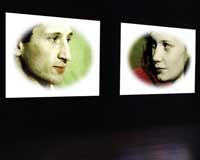
The video installation A Lesson in Tenderness is filmed in close-up. On two screens actors perform the momentary situation when a relationship develops between two people meeting for the first time. The moment is of a tension in which “the word” is absent and feelings are transmitted through facial movements. Each scene is shown twice, the first time very slowly and the second speeded up. This technique allows the viewer to follow even the most insignificant changes in the actor’s expressions and repeat them themselves.
[1] Berger, John. Ways of Seeing. London: Penguin, 1972.
Voor Alexandra Dementieva spelen het gezicht en de gezichtsuitdrukkingen een belangrijke rol in menselijke communicatie. Een vluchtige blik, een glimlach of opgetrokken wenkbrauwen kunnen veel meer overdragen dan woorden. Psychologie wordt toegepast voor verschillende doeleinden bij televisie, film en reclame, media die even geïnteresseerd zijn in het thema van gezichtsuitdrukkingen. Hoe en waardoor wordt een blik gecontroleerd, welke sociale codes worden daarbij geactiveerd en wat zijn de taboe’s van het kijken? Het is bekend dat deze codes gedefinieerd worden door culturele tradities: in Japan hoort de spreker naar de nek van zijn of haar gesprekspartner te kijken, in Nigeria is het een taboe om te kijken naar het gezicht van iemand van hogere sociale status. Mannen kijken naar vrouwen en vrouwen kijken naar zichzelf terwijl ze bekeken worden. Net als in het verleden, worden vrouwen niet zoals mannen gerepresenteerd. De man is nog steeds de ‘ideale’ kijker, een beeld moet hem kunnen vleien. In veel reclameproducties wordt het standpunt van de mannelijke kijker ingenomen, ook wanneer de boodschap aan vrouwen is gericht. De video-installatie Tenderness Lesson van Dementieva is gefilmd in close-up. Acteurs voeren op twee schermen het kortstondige moment van een beginnende relatie op, wat gebeurt er als twee mensen elkaar voor het eerst ontmoeten? Het is een moment van spanning waarbij het woord ontbreekt en gevoelens getransformeerd worden door gezichtsuitdrukkingen. Iedere scène wordt twee keer opgevoerd; de eerste langzaam en de tweede versneld. Hierdoor kan de toeschouwer de kleinste veranderingen in de gezichtsuitdrukkingen volgen en zelf herhalen.